
Incoterms 2020, 2022, or 2023?
ICC first published the Incoterms rules in 1936 and since then they have been the internationally accepted standard for terms interpretation in global trade. From1980 on, the ICC has reviewed and updated the Incoterms rules every ten years to adapt them to current trade practices. The latest version, Incoterms 2020, took effect on January 1, 2020 – and will be valid until 2030.
Incoterms classification
In prior versions, the Incoterms rules were divided into four categories (E, F, C, and D) based on who is responsible for each part of the shipping process.
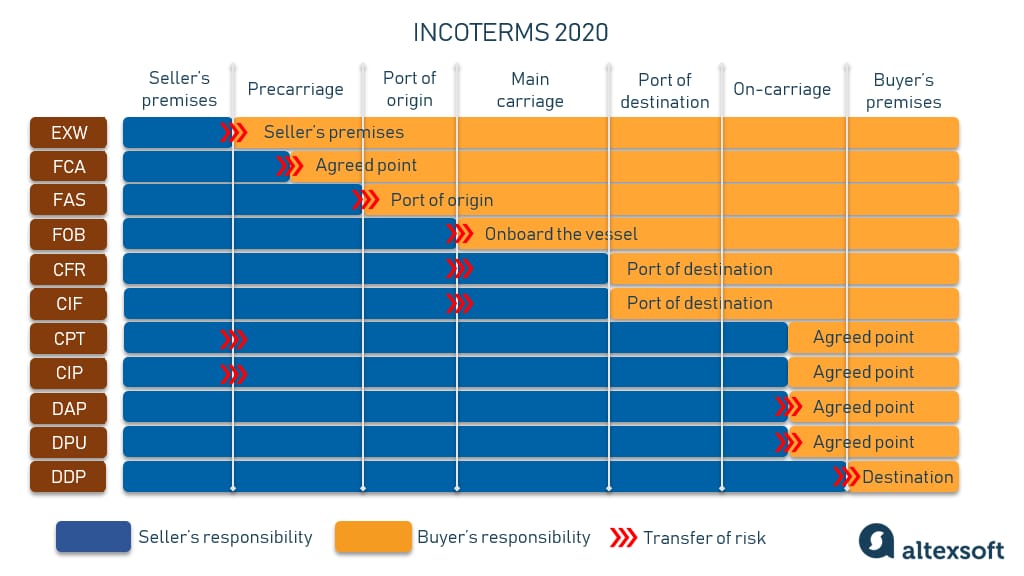
Incoterms 2020 are split into only two categories depending on the means of transportation. One group includes 7 rules (EXW, FCA, CPT, CIP, DAP, DPU, and DDP) that may be applied to any mode of transportation or their combination. The other 4 rules (FAS, FOB, CFR, and CIF) may be used for sea or inland waterway transport – but not for containerized freight.
Let’s look at each of the Incoterms rules one by one. In our overview, we listed the terms based on the changes in the range of responsibilities. We also utilized the terminology accepted by Incoterms to define the stages of the shipment journey:
- precarriage – the transport of goods from the seller’s premises to the port of origin (typically by truck, rail, or inland waterway);
- main carriage – the primary transport stage, usually from one country to another; and
- on-carriage – the transport from the port of arrival in the country of destination to the buyer’s premises (typically by truck, rail, or inland waterway).
Also note that, except for CIF and CIP Incoterms, there’s no obligation for either seller or buyer to provide any kind of insurance. This part must be regulated by the companies’ respective policies and stated in the contract of sale.
Incoterms EXW: Ex Works

EXW Incoterm
Seller obligations: load preparation
Buyer obligations: precarriage, main carriage, on-carriage, export/import customs formalities
Within EXW, the seller has the least responsibility, only having to make the shipment available in the warehouse, factory, or other agreed facility at the specified date.
The buyer handles all the transportation and related hassle, from loading the shipment at the pickup point up to unloading it at the point of destination. All the export/import clearance procedures and duties are also the responsibility of the buyer (though the seller must provide the required data for export clearance).
Incoterms FCA: Free Carrier

FCA Incoterm
Seller obligations: precarriage, export clearance
Buyer obligations: precarriage to the port of origin (if required), main carriage, on-carriage, import clearance
FCA is the most commonly used type of arrangement because of its flexibility. It’s applicable to any type of freight and any kind of transportation (air, water, rail, or truck).
Under FCA, the seller is supposed to deliver the goods to a predefined location at their own cost. It can be their own premises (in this case, the seller is responsible for loading goods on the buyer’s transport), sea/rail/air terminal, the forwarder’s warehouse, or any other agreed place that’s usually in the country of export. The seller also clears goods for export.
The buyer is then responsible for arranging transportation to the final point of destination and import clearance procedures. Risks transfer when the shipment is loaded on the buyer’s transport. FCA provides the importer full control over the shipping process which allows them to choose the most favorable option.
Incoterms FAS: Free Alongside Ship

FAS Incoterm
Seller obligations: precarriage, export clearance
Buyer obligations: loading on the vessel, main carriage, on-carriage, import clearance
Using FAS, the seller delivers the goods to the port of origin and handles all the export clearance. As we said above, this is one of the four Incoterms that can only be applied to non-containerized sea freight and inland waterway transport.
Risk transfers when the goods are placed alongside the vessel that’s arranged by the buyer at the agreed terminal.
Incoterms FOB: Free on Board

FOB Incoterm
Seller obligations: precarriage, loading on the vessel, export clearance
Buyer obligations: main carriage, on-carriage, import clearance
FOB is similar to FAS, except that under FOB, the seller is also responsible for loading the goods on the vessel in due time, bearing all costs and risks up to that point. The seller also clears the goods for export.
FOB is one of the most misinterpreted terms, as it’s often mistakenly used to describe the inland movement of cargo by trucks or rail. However, it should only relate to noncontainerized sea shipments and inland waterway transport.
Incoterms CFR: Cost and Freight

CFR Incoterm
Seller obligations: precarriage, main carriage, export clearance
Buyer obligations: on-carriage, import clearance
CRF indicates that the seller arranges and pays for the shipment of goods to the port of destination – sometimes including unloading from the vessel (if agreed in the contract). The export customs formalities are also the shipper’s responsibility.
The risk moves to the buyer when the cargo is loaded onboard the ship, so if any loss or damage happens while en route, the importer bears the related costs. The buyer is also responsible for import clearance and delivery to the final point.
Incoterms CIF: Cost, Insurance, and Freight

CIF Incoterm
Seller obligations: precarriage, main carriage, export clearance, insurance
Buyer obligations: on-carriage, import clearance
CIF is one of the most popular Incoterms used in global trade because it’s beneficial for both the exporter and importer, offering a reasonable balance of the costs and risks.
CIF requires the seller to arrange delivery to the port of loading, clear the goods for export, arrange and pay for shipping to the port of destination, load/unload freight on/from the vessel, and provide insurance.
Under CIF, there’s minimal insurance coverage required. If that amount is insufficient, the buyer can negotiate with the exporter to take additional coverage (which is usually at the importer’s expense).
As in CFR, the risk passes to the buyer when the cargo is loaded on the vessel. Also, note that both CFR and CIF should only be used when shipping noncontainerized freight by waterway transport.
Incoterms CPT: Carriage Paid To

CPT Incoterm
Seller obligations: precarriage, main carriage, export clearance, on-carriage
Buyer obligations: on-carriage (if required), import clearance
Since CFR and CIF can’t be used outside of noncontainerized sea freight, CPT is the type of arrangement that’s applied when shipping containers or for inland/intermodal haulage. In CPT, the seller arranges export clearance and also contracts and pays for delivering goods to the agreed point of destination. It can be any location in the country of import, so oftentimes, the seller is responsible for transportation from the port to the buyer’s facility.
The risk moves to the buyer when the goods are handed over to the carrier (first carrier in the case of multimodal transport). The buyer also takes care of all import formalities and further transportation.
Incoterms CIP: Carriage and Insurance Paid to

CIP Incoterm
Seller obligations: precarriage, main carriage, export clearance, insurance
Buyer obligations: on-carriage (if required), import clearance
CIP is very similar to CPT we described above, except that the seller is also responsible for providing comprehensive insurance to cover the risk of cargo loss or damage during transportation. The minimum level of insurance coverage is 110 percent of the contractual price.
CIP is often used for multimodal transport.
Incoterms DAP: Delivered at Place

DAP Incoterm
Seller obligations: precarriage, main carriage, on-carriage, export clearance
Buyer obligations: on-carriage (if required), import clearance
Under DAP , the seller is responsible for delivering goods to an agreed location in the country of import further than the port/terminal. So, in this case, the exporter organizes and pays for the export clearance and transportation of cargo from their premises up to any point of destination (e.g., a buyer’s facility, a freight forwarder’s storage, etc.).
The buyer is responsible for unloading cargo and clearing goods for import. The risk transfers once goods are delivered by the seller to the agreed point of destination.
Incoterms DPU: Delivered at Place Unloaded

DPU Incoterm
Seller obligations: precarriage, main carriage, on-carriage (unloading included), export clearance
Buyer obligations: on-carriage (if required), import clearance
DPU has replaced DAT (Delivered at Terminal) in the latest 2020 edition of Incoterms. DPU is similar to DAP except that the seller not only makes sure the goods reach the agreed point of destination but also carries the responsibility of unloading cargo. The seller bears all costs and risks up to that point (including export clearance). The buyer handles the import clearance procedures and transports goods further if necessary.
Incoterms DDP: Delivered Duty Paid

DDP Incoterm
Seller obligations: precarriage, main carriage, on-carriage, export/import clearance
Buyer obligations: unloading at the point of destination
DDP is for courier-type shipments where all the responsibility for transporting goods up to the buyer’s door is on the seller, including all the export and import customs formalities and duties. Usually, the buyer only has to unload the goods on delivery.
How to choose an Incoterm rule: factors to consider
When choosing an appropriate Incoterm to base your contract of sale on, consider the following.
Mode of transport and type of freight. If you plan on shipping by land/air or if you transport containers, you can’t apply FAS, FOB, CFR, or CIF, which may only be used for noncontainerized sea freight.
Level of experience. If you don’t have a lot of experience in international trade and transportation arrangements, it’s worth choosing the Incoterm with the least amount of responsibilities and related risks (e.g., EXW for exporters or DDP for importers).
Level of control. Determine the desired level of control over the shipping process. For example, if you are an importer and you have trusted logistics partners, you might want to arrange transportation yourself. In this case, consider EXW or FCA Incoterms. They give you maximum control over carrier selection, costs, routing, insurance, and other aspects.
Note though that using EXW will require from you as an importer to have the profound knowledge of the logistics nuances in another country.
Level of responsibility and risk. Tightly connected to the level of control come the related responsibilities and risks. You have to assess which risks you are ready to carry and the scope of obligations you are capable of fulfilling.
Insurance policy. Decide who you want to insure goods in question. Remember that only CIP and CIF pose the obligation to insure freight on the seller, requiring different coverage. All other Incoterms allow room for negotiation on insurance.